|
Kumbh Mela
The Indian subcontinent hosts more religious festivals
than anywhere else in the world, but the Kumbh Mela is the biggest and most
mind-boggling of them all. It is, in fact, the largest single gathering of humanity
on the planet.
Historians claim the great mela was founded
by the eighth-century philosopher, Shankaracharya, who masterminded the triumph
of Hinduism in the subcontinent and called for a celebratory gathering of all
ascetics, sadhus, temple priests and monastic orders. Ancient Sanskrit scriptures,
however, tell a different story.
Legend of the Kumbh : According to the Garuda Puran,
once upon a time, Sage Durvasa visited Lord Indra in Heaven and affectionately
offered him a garland. Lord Indra passed on the garland to Airawat, the elephant,
who crushed it under his feet. The furious sage cursed Lord Indra, taking away
all his riches, virtues and power. On learning this, the demon king Bali attacked
Lord Indra, snatching away all his possessions. In the struggle between the
Gods and Demons, the demons were gaining. Seeing this, Lord Vishnu (the preserver
of the universe) advised Lord Indra to regain his lost powers by acquiring amrit
(the divine nectar of immortality) by churning the great sea, Ksheer Sagar.
Mighty mountain Mandarachal was used as a churn staff. The formidable serpent
king Vasuki became the rope to move the churn. Lord Vishnu, in the guise of
a tortoise, gave support from the bottom of the ocean and Lord Brahma guided
the churning from top. As the nectar pitcher (kumbh) emerged, Lord Vishnu handed
it to his winged mount, Garuda, to take to Heaven. As the demons scrambled for
the elixir, some of it spilled on earth at 4 places thereby sanctifying them
forever. These places were Nasik (in the western state of Maharashtra, where
the Godavari or Deccan Ganga flows), Ujjain ( a sacred city in the central Indian
state of Madhya Pradesh) , Haridwar ( in Uttaranchal, where the Ganges flows
into the plains) and Allahabad ( in Uttar Pradesh, where the Ganges, Jamuna
and mythical Saraswati rivers meet). Garuda's flight took 12 days - 12 years
in human time. That is why the Kumbh is celebrated every 12 years, in rotation,
at the above 4 locations.
In some versions of the story, it is Jayanta, the son of Indra, who takes away
the pot of nectar instead of Garuda.
What happens at the Kumbh : All
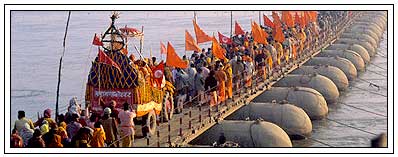
of India's saints, sages, mendicants and fakirs come to the Kumbh city (this
year, Nasik and the nearby Trimbakeshwar ), as do lakhs of pilgrims. To watch
the Kumbh Mela processions is to witness the march of the ages. As the holy
men pass by on their many myriad conveyances - elephants, horses, palanquins,
chariots, cars, and camels - they transmit waves of powerful shakti (energy)
to the watchers. The palpable spiritual vibrations that pervade the entire atmosphere
are overwhelming.
The ambience is an unforgettable blend of religion
and culture. The sights include ash-smeared sadhus and infirm pilgrims sustained
only by faith. Sounds resound, like the chanting of hymns, neighing of horses,
trumpeting of elephants, grunting of camels, bellowing of bulls, beating of
gongs and drums, blaring of trumpets, blowing of conch shells and chiming of
bells. Heady smells of incense and flowers fill the air.
The main rite performed at the Kumbh Mela
is the ritual bath. It is believed that bathing in the Godavari, also known
as the Deccan Ganga, on the auspicious days, during Kumbh, cures the bather
of all sins and evils, and grants salvation.
|